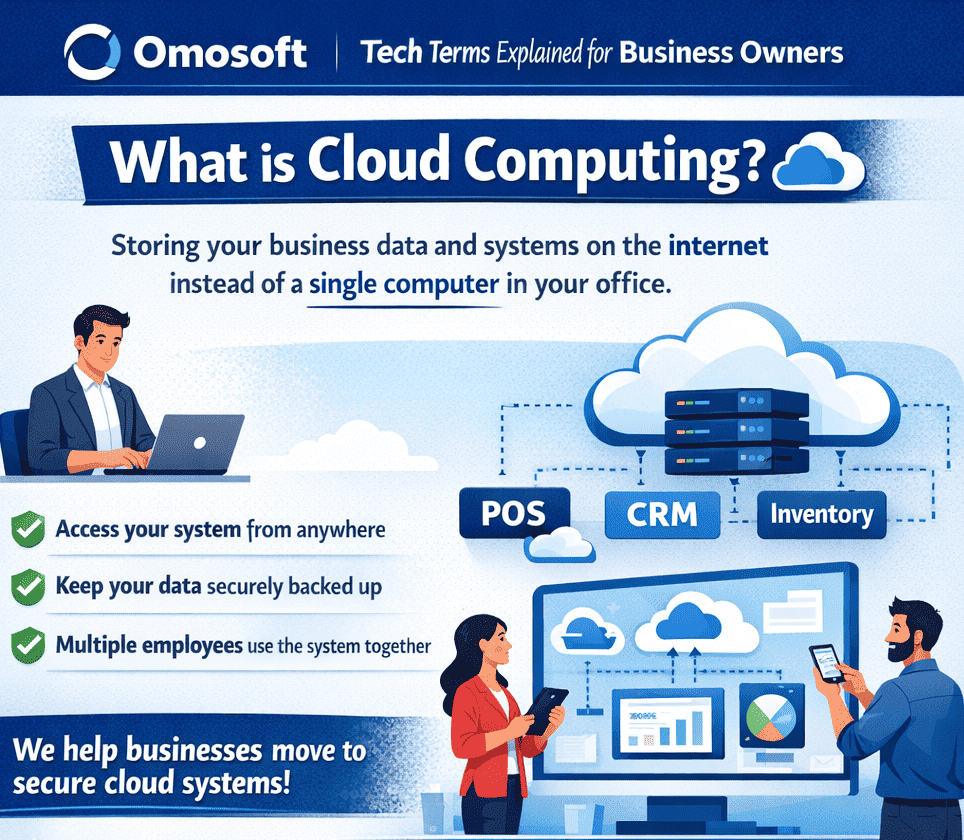
Cloud computing has become one of the most important technologies for modern businesses. From accounting software to inventory management systems, many companies now rely on cloud platforms to run daily operations.
But
what exactly is cloud computing, and why are businesses moving to the cloud?
In
this guide, we explain cloud computing in simple terms, its benefits,
examples, and why it is transforming how businesses operate.
Quick
Answer: What Is Cloud Computing?
Cloud
computing is the delivery of computing services such as storage, databases,
software, and servers over the internet instead of using a local computer or
physical server.
This
allows businesses to access their systems and data from anywhere using an
internet connection.
Example:
Instead of installing software on an office computer, employees log into the
system online.
Table
of Contents
- What
Is Cloud Computing?
- How
Cloud Computing Works
- Types
of Cloud Computing
- Benefits
of Cloud Computing for Businesses
- Real
Examples of Cloud Computing
- Is
Cloud Computing Secure?
- Why
Small Businesses Should Move to the Cloud
- How
Omosoft Technologies Helps Businesses Adopt Cloud Systems
- Frequently
Asked Questions About Cloud Computing
How
Cloud Computing Works
Cloud
computing works by hosting applications and data on remote servers located
in secure data centers.
Instead
of storing information on a single office computer:
- Data
is stored on powerful cloud servers.
- Users
access systems through the internet.
- Cloud
providers manage security, updates, and maintenance.
This
eliminates the need for businesses to maintain their own IT infrastructure.
Types
of Cloud Computing
Understanding
the different types of cloud computing helps businesses choose the right
solution.
1.
Public Cloud
Public
cloud services are hosted by third-party providers and shared by multiple
users.
Examples
include platforms offered by Amazon Web Services and Microsoft Azure.
2.
Private Cloud
A
private cloud is dedicated to a single organization. It provides greater
control and customization.
This
model is often used by large enterprises or organizations handling sensitive
data.
3.
Hybrid Cloud
A
hybrid cloud combines public and private cloud environments.
Businesses
use this model when they need both flexibility and enhanced security.
Benefits
of Cloud Computing for Businesses
Cloud
computing offers several advantages that make it attractive for modern
businesses.
1.
Access Your Systems from Anywhere
Employees
and business owners can access systems remotely using laptops, tablets, or
smartphones.
This
is especially useful for remote work and multi-location businesses.
2.
Lower IT Costs
Cloud
computing reduces the need for expensive hardware such as servers and storage
devices.
Businesses
typically pay only for the services they use.
3.
Automatic Data Backup
Cloud
platforms automatically back up data, reducing the risk of losing important
business information.
4.
Better Team Collaboration
Cloud-based
tools allow multiple employees to access and update the same system
simultaneously.
5.
Scalability
Businesses
can easily increase storage, users, or features as they grow.
This
makes cloud computing ideal for startups and expanding companies.
Real
Examples of Cloud Computing
Many
popular business tools are cloud-based, including:
- Online
accounting software
- Customer
Relationship Management (CRM) systems
- Inventory
management platforms
- Cloud-based
POS systems
- Business
analytics dashboards
These
systems allow businesses to manage operations efficiently without installing
complex software.
Is
Cloud Computing Secure?
Security
is one of the most common concerns when adopting cloud technology.
Modern
cloud platforms use advanced security technologies such as:
v data encryption
v multi-factor authentication
v firewalls
v continuous monitoring
v automated backups
In
many cases, cloud environments provide stronger security than traditional
office computers.
Why
Small Businesses Should Move to the Cloud
Small
businesses benefit significantly from cloud computing because it:
v reduces technology costs
v improves operational efficiency
v enables remote work
v protects business data
v allows businesses to scale quickly
This
is why cloud adoption continues to grow among startups and SMEs.
How
Omosoft Technologies Helps Businesses Move to the Cloud
Omosoft
Technologies helps businesses implement modern cloud solutions that improve
productivity and streamline operations.
Services
include:
v Cloud-based business systems
v POS and inventory management
software
v Business automation solutions
v Custom software development
v Technology consulting
By
adopting cloud technology, businesses can operate more efficiently and compete
in the digital economy.
Frequently
Asked Questions (FAQ)
What
is cloud computing in simple terms?
Cloud
computing means storing and accessing software and data through the internet
instead of a local computer.
What
are examples of cloud computing?
Examples
include online accounting software, CRM systems, and cloud-based POS platforms.
Is
cloud computing safe for businesses?
Yes.
Cloud providers implement strong security measures such as encryption, backups,
and secure authentication.
Why
do companies use cloud computing?
Companies
use cloud computing because it reduces IT costs, improves accessibility, and
allows systems to scale as businesses grow.
Conclusion
Cloud
computing has transformed the way businesses manage technology. By moving
systems and data to the cloud, organizations gain flexibility, security, and
scalability.
For
businesses looking to modernize operations, cloud computing is one of the most
powerful digital tools available today.



)